For many families homes are where comfort as well as security meet. However, if a loved one has multiple prescriptions daily, regulating the medications can be an essential element of a secure home-care routine.
Imagine an older person returning home from hospitalization. There are brand new prescriptions on the counter in the kitchen and an old bottle of medication on the counter along with handwritten notes from an individual in the family. The schedule could comprise one medicine every morning. a different one along with food, and a third when it’s time to go to bed. If you are a family caregiver who is having to balance work, kids and other responsibilities, organizing everything can be overwhelming.
This is the point at which an effective medication administration system and management of medications at home can make a huge difference.
Medication administration is the act of giving or helping with medication as per the patient’s health plan, prescriptions and any applicable legal and professional guidelines. If the information on medications is correct and instructions are followed and communication between nurses, caregivers, patients as well as pharmacists and physicians is constant it can make the home a more secure and organized setting for medical care.
We are Alliance Home Healthcare Services Our skilled nursing services offer medication administration and control as part of our individualized home healthcare assistance. Our aim is to assist families and patients maintain an enlightened, coordinated treatment plan in the comfort of their home.
What Is Medication Administration in Home Care?
Medication administration in the home care is the procedure of administering or helping by prescribing medications as per the care plan of the patient and any applicable guidelines.
Based on the needs of the patient and the kind of medication used, treatment may include responsibilities like:
- Examining the latest medication information
- In accordance with the prescribed schedule of medication
- The administration of medication is permitted and necessary
- The support of medications routines
- Be watching for signs of changes or concerns
- Making relevant observations available to the appropriate health professional
- Ensuring that families and patients are aware of the dosage instructions for medications.
- Maintaining accurate documentation in accordance with the requirements
All medication administration must be determined by the specific medical needs of each patient and the expertise of the physician who is providing the medical care.
The Centers for Disease Control and Prevention states that medicines are safe when taken as recommended or in accordance with instructions on the label and highlights medication errors and adverse drug interactions as significant safety concerns for patients.
Why Medication Safety Matters in Home Care
The importance of ensuring the safety of medications is especially important when patients are managing multiple prescriptions, encounter changes in their health, or move between different healthcare settings.
Patients may be given an updated prescription following an admission to a hospital, while still taking medication prescribed prior to the hospitalization. If there isn’t an up-to-date and accurate medication list, the differences between prescriptions from the past and those for the present are often not noticed.
The Agency for Healthcare Research and Quality (AHRQ) defines medicine reconciliation as the process of comparing the current regimen of a patient’s medication with the prescription medication to determine and fix unintentional differences.
This is particularly relevant when a patient is transitioning between hospital and home. AHRQ study of patients who were moving from hospital to home treatment found that drug interactions could pose a risk for adverse drug reactions.
Common Medication-Related Challenges at Home
Families could face difficulties for example:
- Inadvertently missing a dose
- Similar names of medications are often confused.
- Making use of an outdated list of medicines
- Misunderstanding instructions
- Utilizing prescription or over-the-counter medications without revealing the full list of medications
- It is difficult to organize multiple medications
- Changes in medications following hospitalization
- A difficult time remembering if a medicine was previously taken
- Communication gaps between healthcare providers.
- It is difficult to comprehend changes to a medication regimen
These issues do not necessarily suggest that a family is not doing things right. The schedule of medications can become complex, especially when the patient suffers from chronic health issues as well as multiple prescriptions.
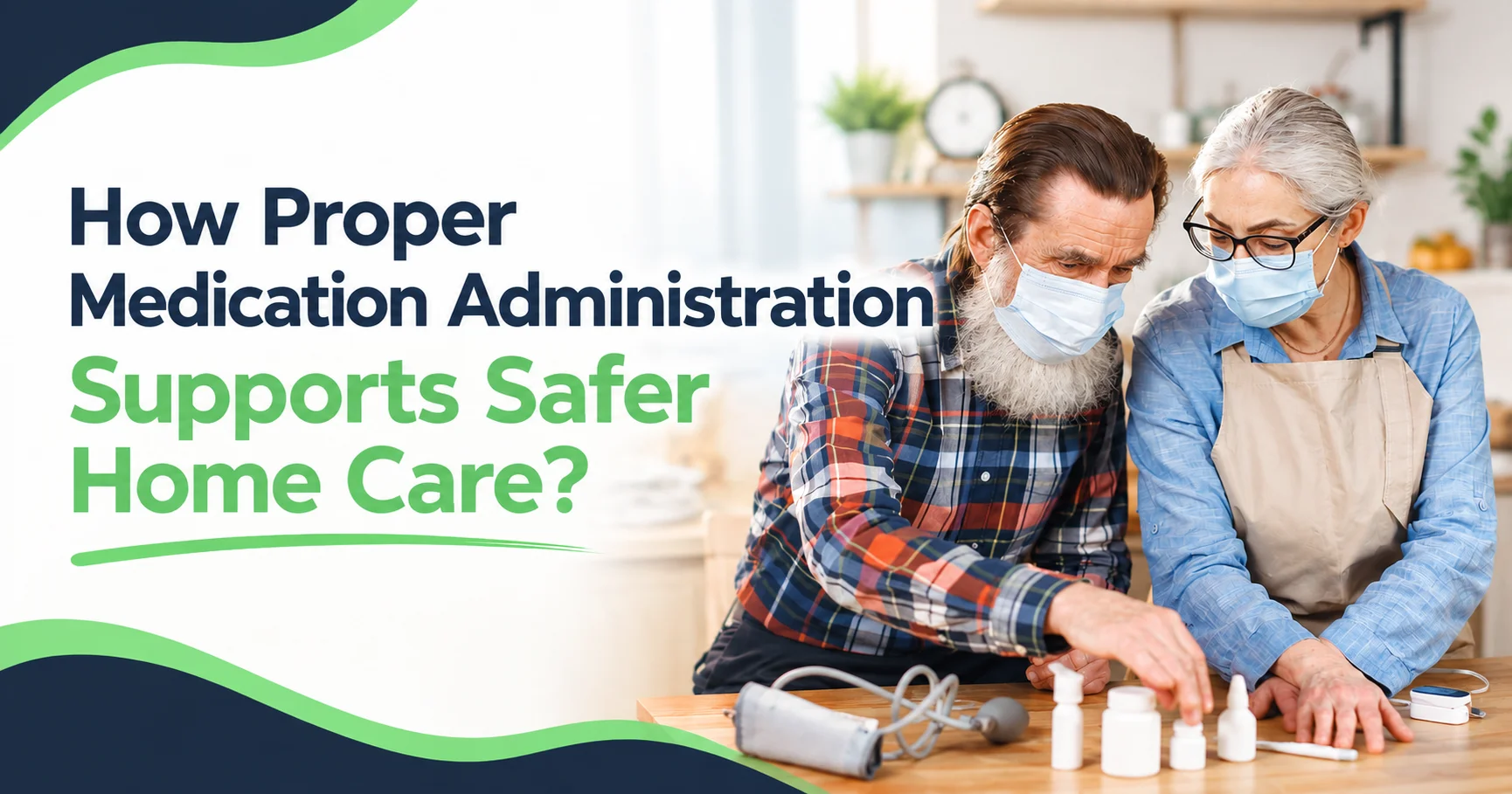
How Proper Medication Administration Supports Safer Home Care
The proper administration of medication isn’t only about remembering to administer the pill at a specific moment. It’s part of a larger set of medication security as well as documentation, communication and patient education health coordination.
1. It Helps Maintain an Organized Medication Routine
An established medication regimen can ease daily care for caregivers and patients.
If the medication’s instructions are clearly understood and integrated into a routine of care There is less confusion regarding what is required and when.
A caregiver, for instance, can coordinate medication-related tasks alongside other daily tasks like meals and individual care and mobility aid or appointments, in accordance with the patient’s plan.
A routine that is organized can help you recognize any time things have changed.
2. It Supports Accurate Medication Information
A complete medication list is a crucial basis for managing medications.
A complete list might comprise:
- Prescription medication
- Medicines that are available over-the-counter
- Vitamins
- Supplements
- Topical medicines
- Eye drops
- Other products that are relevant
AHRQ insists on getting, verifying, and recording details about medications for medication reconciliation.
Maintaining current information on medications can assist the team of healthcare professionals to spot gaps and help them communicate more effectively.
3. It Helps During Transitions of Care
The most critical instances of ensuring the safety of medications occurs when the patient goes from one place of care to another.
This could happen when:
- Returns home after hospitalization
- Leaves a rehabilitation center
- Healthcare at home begins
- Have you seen a medicine changed by a doctor
- A new specialist is discovered.
- Changes in health conditions
During these changes, medications lists can quickly change.
AHRQ states that reconciliation of medications can help identify potential distinctions between medications when a patient is in transition.
Family members, this can be a great chance to ensure that all caregivers are using the most up-to-date information available.
4. It Encourages Better Communication
The safety of your medication is a collective effort.
Family caregivers, patients as well as home healthcare professionals, pharmacists and doctors might all have details regarding a patient’s medication routine.
Communication is essential to ensure that concerns, changes and queries are dealt with by the correct health expert.
AHRQ suggests the clear and concise communication of information about medications throughout the transition and stresses that it is important to resolve any unintentional differences with the appropriate physician.
5. It Supports Patient and Family Education
Sometimes the most valuable aspect to medication control is helping the patient or caregiver to understand the routine of their medication.
Questions could be based on:
- What exactly is this medicine used for?
- When is it appropriate to take it?
- What should be the procedure to follow?
- What guidelines were given by the professional who prescribed medication?
- What do the patient or their caregiver do if there’s concern?
- To whom should you reach out if needing clarification?
The FDA suggests asking questions, keeping the medication list, observing instructions, and then storing and disposing of medications safely.
Education can help families gain clarity, while also helping them communicate with healthcare professionals who are qualified for any questions regarding medication.
Medication Management as opposed to. Medication Administration
Although the terms are similar, they aren’t identical.
What Is Medication Administration?
The administration of medication concentrates on the process of administering medication in accordance with the prescription that is authorized, the health plan, and other applicable regulations.
What Is Medication Management?
Management of medication is more extensive. It could include organizing information about medications as well as reviewing medication regimens and identifying any discrepancies, aiding in communication, and assisting patients and their caregivers comprehend their medications within the proper scope of treatment.
AHRQ defines medication management as consisting of an accurate and complete medication list as well as reconciliation of medications to detect potential safety concerns.
Both ideas can lead to an improved coordination approach to home health.
Who May Benefit From Medication Administration Support at Home?
Home healthcare assistance for medication may be beneficial to those who are undergoing complex medication regimens or require skilled nursing assistance.
This could include:
Older Adults
Adults over the age of 65 may be taking various medications to treat chronic illnesses which makes communication and organization crucial.
Individuals With Chronic Conditions
Patients who are suffering from conditions like cardiovascular disease, diabetes, respiratory disorders, neurologic disorders, or any other chronic illness might have a regular medication regimen.
Patients Recovering After Hospitalization
The need for medication changes is commonplace in the transition from hospital to the home. Re-reading and sharing the most current information about medications can help lessen confusion.
Individuals With Mobility Limitations
Someone who is having difficulty getting around their home might be unable to independently access medications or sustain an established routine.
People Requiring Skilled Nursing
Some patients are suffering from medical conditions which require professional nursing care and individual monitoring in accordance with the care plan they have been given.
Children With Complex Medical Needs
Children who receive pediatric home health may require specific medication regimens in conjunction with a wider treatment plan. Children’s medication administration should be done in accordance with the prescription, expert guidance, and the applicable regulations.
A Simple Story: When a Medication Routine Becomes Manageable
Think of an older gentleman called David.
After returning from the hospital David experienced several changes in his medication. His daughter was eager to assist but was worried since one of the bottles had been removed while a different medication was added.
Every morning, she thought which medication Dad should use in the present? Was the hospital able to change anything? Does this bottle remain in his plan?
Instead of speculating, the family consulted the right healthcare professionals to understand the current medications and the care guidelines.
With a well-organized medication regimen and improved communications, family members felt more secure about the information that was required to be adhered to and what questions should be addressed to the medical team.
The most significant change was not just the organization of medication bottles on the counter.
It was experiencing clearness.
This clarity can be extremely important for families that provide support at home.
Practical Medication Safety Tips for Families
Families can take various practical steps to help support the safety of their medication.
Keep an Updated Medication List
Note the current medications and any pertinent instructions issued by your medical professional.
Include prescription medicines, over-the counter products, vitamins and other supplements as needed.
Bring Medication Information to Appointments
A current medication list in hand can assist healthcare professionals to understand the patient’s current medication regimen.
Ask Questions When Instructions Are Unclear
Don’t make assumptions about an instruction for a medication. Consult the physician or pharmacist, nurse or any other health professional to get clarification.
Communicate Medication Changes
Let the appropriate people on the health care team if the medication is being taken or stopped, altered or stopped.
Store Medications Safely
Follow the instructions for storage of your medication and make sure that your medication is secure, particularly when children or vulnerable persons are present at home.
Watch for Changes and Report Concerns
If you notice an unintentional reaction or changes, seek medical assistance immediately.
These methods can be used in conjunction with the services of a professional home health care provider and aid in establishing a more secure regimen for medication safety.
For families looking for compassionate, personalized care at home, Alliance Home Healthcare Services provides support designed around each individual’s needs, preferences, and established care plan.
How Alliance Home Healthcare Services Supports Safer Home Care
We at Alliance Home Healthcare Services we recognize that home health care is about more than just completing tasks. It’s about ensuring that patients receive well-organized, respectful, and personalized care.
We provide Skilled nursing services comprise:
- Skilled Nursing Visits
- Medication Administration
- Medication Management
- Wound Care
- Post-Surgical Care
- Chronic Disease Management
- Health Assessments
- Patient & Family Education
- Physician Coordination
We also offer Nursing Private Duty Nurse services comprise:
- One-on-One Nursing Care
- Long-Term Medical Care
- Complex Medical Care
- Tracheostomy Care
- Feeding Tube Care
- Catheter Care
- IV Therapy
- Ventilator Support
For children for whom we offer pediatric home care services may consist of pediatric skilled nurses, nurse on private duty, personal care, feeding tube and ventilator treatment, support for the developmentally disabled as well as education for caregivers and families, in accordance with individual requirements and the applicable needs.
Our focus is on the patient’s specific plan of care as well as the particular care needed at home.
Medication support is often one part of a broader care plan. Families can explore our home healthcare services to learn more about the different types of personalized support available for individuals who need assistance at home.
Why Families Choose Home Healthcare for Medication Support
Home healthcare is an important link between medical requirements and daily life.
Instead of requiring an individual in the family to handle the entire treatment routine, professional home health care can provide the right assistance in accordance with the patient’s treatment plan.
For families living in and in the vicinity of Fredericksburg, Virginia, Alliance Home Healthcare Services offers a range of home health care services based on the individual requirements.
The familiar surroundings of home will also allow patients to maintain routines, get one-on-one attention and stay connected to the people and their surroundings they value most.
Frequently Asked Questions About Medication Administration at Home
What is the purpose of medication administration in the home health care setting?
It is the act of administering or helping with prescription medications in accordance with the patient’s care plan and any applicable prescriptions. The specific responsibilities are based on the needs of the patient and the skills and experience of the healthcare professional who provides the care.
When medication routines become difficult to manage independently, professional support may provide greater structure and peace of mind. Learn more about our Medication Administration Services in Fredericksburg and how care can be tailored to individual needs and established care plans.
Why is it important to manage medication for elderly people living at home?
Medication management is a way to organize medication information, facilitate communication, and uncover the underlying issues in a routine. This can be especially crucial for those who are older and take several medication.
What is a medication reconciliation?
Medication reconciliation is the act of preparing and verifying an accurate list of medications and then comparing it with prescription orders to determine if there are any unintentional differences.
Do home health services help after discharge from the hospital?
Yes. Home healthcare could provide support following hospitalization based upon the plan of care for the patient. Information about medications is particularly important when undergoing a transition because the medication regimen can be altered.
Can Alliance Home Healthcare Services provide the administration of medications?
Yes. medication Administration as well as Medication Administration are part of Alliance Home Healthcare Services’ skilled nursing services, which are subject to the requirements of the patient’s medical plan of care, the scope and quality and any applicable conditions.
What Is Pediatric Personal Care at Home?
Personal care for children at home is a non-medical aid to children who are in a familiar family environment. The aim is to assist children to engage in daily activities while encouraging safety as well as dignity, comfort as well as overall health.
Children may require personal aid due to physical disabilities, developmental disabilities or mobility issues, chronic illnesses or other specific needs.
Based on an individual treatment plan, the personal care could comprise:
- Bathing assistance
- Cleaning and grooming
- Dressing assistance
- Incontinence and toileting
- Help with feeding
- Transfer assistance and mobility
- Reminders for medication
- Prevention of falls
- Security supervision
- Social engagement
- Assistance with routines of daily life
The services that provided to a child should be determined by their requirements and the plan of care developed with their parents and the appropriate health experts.
Why Do Children Need Pediatric Personal Care?
Each child’s development is unique. Some children may require short-term support following an accident, illness or hospitalization. On the other hand, others might require continuous support due to a disability or chronic health issue.
Parents, juggling these demands while also managing household chores, appointments as well as other children can be emotionally and physically stressful.
Personal care for children can offer extra support, but without taking parents from their child’s world.
Supporting Children With Special Needs
Children who have physical or developmental disabilities may require assistance with routine activities that children are able to do independently.
A caregiver may provide the adequate support by:
- Personal hygiene
- Dressing
- Feeding and eating routines
- Safely moving around the house
- Toileting
- Daily activities
- Security supervision
The aim is not only to accomplish the tasks of a child. A good pediatric care system should encourage the child’s participation and independence at all times that are appropriate.
Helping Children Maintain Familiar Routines
Children are often more relaxed when their routines are predictable.
The care provided at home lets children remain in a familiar setting where they can be familiar with their surroundings, belongings, family members, and their daily routines.
The familiar surroundings can make routines for personal care more comfortable and less invasive.
8 Benefits of Pediatric Personal Care at Home
1. Children Receive Care in a Familiar Environment
One of the most significant advantages of care for children at home is that children receive help in the space that they are most at ease, which is their home.
The home is a familiar place. It includes the child’s bedroom and toys of choice relatives, as well as the routine of life.
If your child is uneasy in unfamiliar surroundings having a personal caregiver from home could make the daily tasks easier to manage.
A home that is familiar to children can enable caregivers to know how a child behaves and communicates, plays or eats and also interacts with relatives.
2. Personalized Care Based on the Child's Needs
There are no two children exactly identical.
A child might require assistance with dressing and bathing and another might require assistance with feeding, mobility or more intensive supervision.
The personal care of a child at home is able to be tailored to meet the individual needs of each child and routines for the family.
Support for individuals may be focused on:
- Daily personal hygiene
- Mobility
- Feeding
- Dressing
- Toileting
- Safety
- Social interaction
- Routine development
This unique approach allows families to get support that is appropriate to their child’s situation instead of being dependent on a universal routine.
3. Greater Comfort and Emotional Security
Children are often nervous when they are in the presence of strangers or are placed in unfamiliar surroundings.
Home is a place that gives you a sense of familiarity and security.
Imagine that a child requires assistance getting ready for school every morning. Instead of running through the morning routine or feeling overwhelmed, a caregiver could assist the child in dressing or grooming, breakfast mobility, and many other tasks while the child stays in their regular surroundings.
These small moments can be a significant change to the morning routine of your family.
4. Parents Receive Valuable Support
Pediatric health care doesn’t only help children. It also provides essential support to parents and caregivers for the family.
Parents are often juggling many responsibilities at the same time. They may have to organize the schedule of their children’s school and appointments for medical care, household duties as well as work, and also their child’s care needs.
The presence of a trained caregiver who can provide adequate assistance to parents can allow them the time to concentrate on other tasks while knowing that their child is supported.
It is not a substitute for the relationship between parents and children. It is a way to assist parents in maintaining a healthy equilibrium between family and caregiving life.
5. Improved Safety at Home
Children with mobility impairments or developmental disabilities, as well as other disabilities may be faced with more safety concerns during their daily activities.
Personal care for children may include supervision of safety and help with transfers and mobility.
Caregivers could help decrease the risk of a typical household by assisting children in activities like:
- Transferring from one room to another
- Getting dressed
- Bathing
- Bathroom use
- Eating
- Transfers
- Daily routines
Families also gain from the identification of safety issues that could be present in the home and establishing routines that promote safer movements.
6. Assistance With Feeding and Daily Activities
Children may require extra help for mealtimes and other daily activities.
Assistance with feeding can aid children who are struggling to manage food on their own, and caregivers can also help them maintain regular, healthy routines.
Based on the child’s treatment plan, help could include:
- The preparation of the child’s meal
- Helping with food preparation
- Supporting comfortable positioning
- Encouragement of the appropriate participation
- Follow the established care guidelines
If your child has more complex medical requirements, pediatric skilled nursing might be more appropriate than just personal care.
7. Encourages Independence and Confidence
Being assisted is not a sign that the child is not able to develop independence.
Indeed, the proper assistance can allow children to practice abilities at their own speed.
The caregiver could let children to take part in dressing up by deciding on clothes or putting on a portion of a dress, even completing an additional step that can be managed.
In the same way, when grooming or feeding times, the caregiver should help the child participate when it is appropriate.
Small achievements like these can boost confidence.
As time passes, children will become more comfortable in daily activities, and develop more independence.
8. Provides Respite for Family Caregivers
Being a caregiver for a child who has extra requirements can be rewarding, however, it can be stressful.
Parents and caregivers for the family need the time to rest and work, go to appointments, connect with other family members or just recharge.
Personal care for children can be used with programs for respite to offer families short-term support.
Respite care can offer choices like the hourly respite option, daily respite, weekend care holiday coverage, or respite care, based on the availability of care and the family’s requirements for care.
Compassionate Care Starts With One Phone Call
Get in touch with Alliance Home Healthcare Services today to schedule your FREE in-home consultation and discover how our experienced caregivers can improve your loved one’s quality of life. If you’re wondering how to choose the right home healthcare provider, our compassionate team is here to answer your questions, explain your care options, and create a personalized care plan that meets your family’s unique needs.

Pediatric Personal Care and Pediatric Skilled Nursing: What's the Difference?
Families need to know that individual health care, as well skilled nursing do not provide the same kind of services.
Personal care for children typically focuses on helping in daily activities like health and hygiene for the individual, food safety, regular assistance.
For instance the pediatric skilled nursing service could be suitable for children who need services like:
- The administration of medications
- Care for feeding tubes
- Tracheostomy treatment
- Ventilator care
- Medical monitoring complex
- Private duty pediatric nursing
The best type of care is based upon the individual child’s medical condition and individual needs. Families must work with their healthcare professional and their home healthcare provider to determine the degree of care is necessary.
How Pediatric Home Care Helps Parents and Families
More Time for Family
When caregivers assist in the proper daily chores parents can be able to concentrate on family-focused moments instead of juggling the caregiving burden on their own.
It could be sitting down for breakfast as well as aiding with schoolwork, or playing your favourite game, or just enjoying the time spent together.
Reduced Caregiver Stress
Parents are naturally inclined to provide the highest quality support to their kids. But carrying all of the responsibility on your own can be exhausting.
In-home assistance from a professional can be another level of support that is reliable.
Parents are able to remain involved, while receiving assistance in proper daily care obligations.
Greater Peace of Mind
Knowing that a qualified caregiver can be there to help children can give them reassurance.
Families can create routines that meet the needs of their children while keeping the privacy and comfort in their own homes.
Who Can Benefit From Pediatric Personal Care at Home?
Personal care for children may be beneficial to children who require assistance in their daily activities due to:
- Developmental disabilities
- Physical impairments
- Mobility restrictions
- Chronic diseases
- Recovery following hospitalization
- Special healthcare needs
- Feeding challenges
- Personal hygiene difficulties
- Security issues
- Achieving daily tasks living independently
The best services will depend on the individual child’s requirements and the care plan.
What Does Pediatric Personal Care at Home Include?
Personal Hygiene
Caregivers can assist with grooming, bathing, dressing, and toileting.
Mobility Assistance
Children who are unable to move in a safe manner may be offered assistance with the transfer of their bodies and with mobility.
Feeding Assistance
Caregivers can help children eat in accordance with their established guidelines and care plan.
Safety Supervision
Children who require extra supervision can receive assistance created to ensure a safe home setting.
Social Engagement
Social engagement and interaction that is age-appropriate can make routines more enjoyable and positive.