
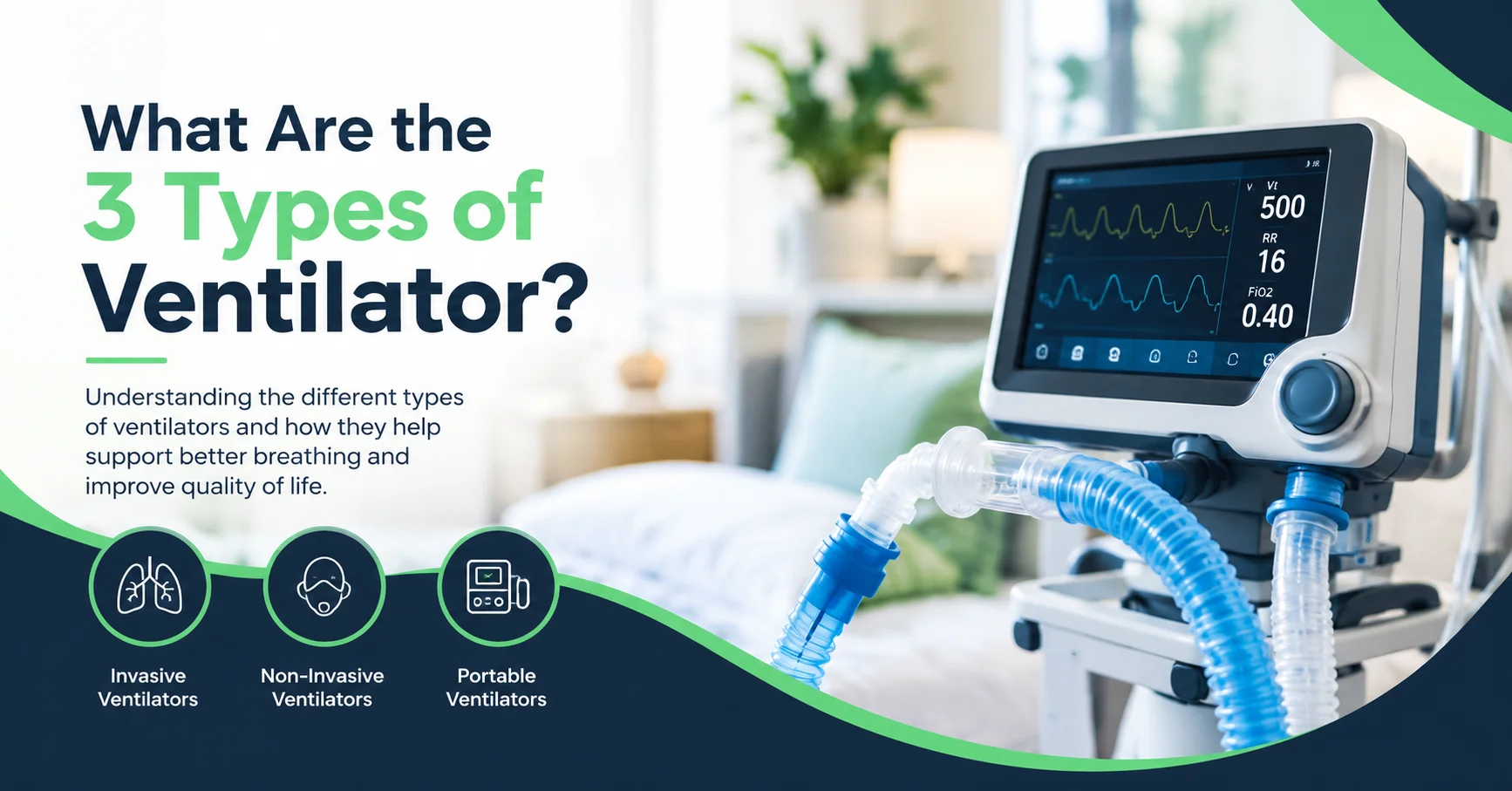
If a loved one starts suffering from breathing problems family members may be faced with learning a new language such as mechanical respiration, breathing support, CPAP, BiPAP, tracheostomy or invasive ventilation, as well as ventilators for homes. It can be overwhelming, particularly when someone you cherish is dependent on a machine that helps them breathe.
You might have looked online in search of “what are the three kinds of ventilators?” because you would like to know the basics of the different options and the implications for patients receiving treatment.
A ventilator, also known as a respirator or breathing machine is a device that helps to move air in and out of lungs in cases where a person is unable to breathe independently. Based on the individual’s health the ventilator can provide temporary support in a hospital setting or, in certain circumstances it can provide long-term respiratory assistance at home.
It is essential to recognize that medical professionals categorize ventilators as well as ventilation in many different ways. There is no widely accepted list of three different types of ventilators. Families can however understand the main methods by looking at ways in which the respirator provides breathing assistance.
The following guide will help you understand the three categories. We’ll define three broad categories:
- Invasive positive-pressure ventilation
- Noninvasive positive-pressure ventilation
- Negative-pressure ventilation
We will also go over CPAP, BiPAP, tracheostomy ventilation, home ventilation and what parents should be aware of when caring for a patient who requires breathing support.
What Is a Ventilator?
A ventilator is a medical device designed to help people breathe. It is able to push air occasionally with oxygen in the lungs, and aid in the removal of carbon dioxide from your body.
Mechanical ventilation is a possibility in cases of severe respiratory difficulties, breathing problems, respiratory conditions, neurological issues and injuries or medical conditions that make breathing difficult.
A ventilator will not treat the medical condition that caused it. It is a breathing assistance while medical professionals treat the root cause or manage a long-term illness.
For some, the need for ventilation can be only temporary. Some may require longer-term support for their respiratory system due to the progression of a chronic medical disease.
For families looking for reliable support at home, Alliance Home Healthcare Services provides personalized home healthcare designed around each client’s individual needs.
Why Might Someone Need a Ventilator?
A doctor may suggest mechanical ventilation in cases where a person can’t get enough oxygen in the blood or is unable to eliminate the carbon dioxide in sufficient quantities.
The most common situations involving mechanical ventilation are:
- Severe respiratory illness
- Certain lung diseases
- Respiratory failure
- Infections that are serious
- Conditions related to neuromuscular disorders or neurology
- Severe injuries
- Complications that can occur following surgery
- Long-term breathing difficulties
The precise treatment is contingent upon the patient’s medical condition, breath ability diagnosis, and overall treatment plan.
What Are the 3 Types of Ventilators?
1. Invasive Positive-Pressure Ventilation
Invasive ventilation provides breathing support via an artificial airway, instead of a face-mask.
A doctor may insert an endotracheal tubing through the mouth into the windpipe or an individual may be given a tracheostomy through an incision inside the neck. The ventilator is then connected to the airway.
This kind of ventilation is typically utilized when someone requires a significant amount of respiratory support or is unable to maintain a safe level of breathing without a ventilator.
When Is Invasive Ventilation Used?
Mechanical ventilation can be utilized in circumstances like:
- Respiratory failure severe
- A serious illness that requires urgent care
- Major surgery
- Certain neurological disorders
- Severe lung problems
- Long-term ventilator dependence
If you are a patient who requires long-term care, a tracheostomy can be used to provide the airway through which the ventilator can provide breathing assistance.
Invasive Ventilation at Home
Certain patients with medical conditions might eventually be able to transition from hospital care to home ventilation. The National Heart, Lung, and Blood Institute states that home ventilation is an option for those suffering from chronic illness if the right training caregivers, support for nursing and other support are in place.
The transition for families could be a difficult one. The machine that was once daunting can now be an everyday routine, such as lying beside their bed, travelling with them and helping them breathe during the day and the night.
2. Noninvasive Positive-Pressure Ventilation
Noninvasive ventilation, commonly abbreviated as NIV, offers breathing assistance, without the need to insert any artificial air tube in the windpipe.
The person typically breathes through a fitted mask that is connected to an apparatus. Cleveland Clinic identifies CPAP and BiPAP as the most common types of non-invasive breathing.
This method can be beneficial for those who are breathing normally, but require breathing support.
What Is CPAP?
CPAP refers to Continuous Positive Airway Pressure.
A CPAP machine offers a constant amount of airway pressure that is positive to ensure that the airway stays open. It is typically connected with sleep apnea however, positive airway pressure treatments are also used in other medical conditions according to the advice of a medical physician.
What Is BiPAP?
BiPAP is also known as BPAP is a reference to Bilevel Positive Airway Pressure.
In contrast to CPAP that generally offers the same amount of pressure for inhalation and exhalation BiPAP offers a greater level of pressure while breathing in, and less pressure when exhaling.
BiPAP is a treatment option in certain situations that cause difficulties in moving air or eliminating carbon dioxide, such as some instances of COPD sleep-related breathing problems, respiratory failure and muscle weakness.
CPAP in comparison to. BiPAP
The easiest way to comprehend the difference is to:
CPAP: One continuous pressure.
BiPAP There are two pressure levels, one for inhalation, and one to exhale.
There is no way to guarantee that it will be appropriate for everyone. A medical professional will determine which kind of respiratory support is suitable based on the person’s health.
3. Negative-Pressure Ventilation
Negative-pressure ventilator is a second technique for mechanical support of the respiratory system. Instead of directing oxygen directly to the lung via masks or airways The equipment creates negative pressure on the chest in order to draw air into the lungs.
This technique is less widespread than modern positive-pressure air ventilation.
The past was when devices such as those that were known as the iron lung offered negative-pressure airflow by generating pressure changes throughout the body. Mechanical ventilation in the modern age is primarily built on systems of positive pressure.
How Does Negative-Pressure Ventilation Work?
The concept at its core is akin to breathing naturally.
When the pressure in the chest drops the chest expands as air flows through the lungs. If the pressure increases again, air flows out.
While negative-pressure ventilation holds an important role in the history of medicine for respiratory conditions however, today’s families are more likely to experience positive-pressure, specifically the noninvasive type of ventilation like CPAP and BiPAP.
What Is the Difference Between Invasive and Noninvasive Ventilation?
One of the most crucial family members should be aware of is the way that the ventilator connects to the individual.
Invasive Ventilation
- Makes use of an artificial airway
- Could be an endotracheal tube.
- Could require the need for a tracheostomy
- It can provide significant breathing assistance
- Most often, it is used in severe or complicated medical situations
Noninvasive Ventilation
- Typically, one uses a face or nasal mask
- Do not need an artificial airway.
- Forms include CPAP and BiPAP
- It is possible to use it for specific chronic or acute breathing problems.
The best method is based on the individual’s ability to breathe and diagnosis, medical stability and the advice of the healthcare professional.
What Is a Home Ventilator?
Home ventilators are ventilators that can be utilized outside of a hospital setting for those who require long-term respiratory assistance.
There are some who do not believe that everyone who utilizes a ventilator is able to receive treatment at home. Ventilation at home requires medical planning equipment as well as training, caregiver preparation and support from a professional.
Based on the person’s requirements The home respiratory apparatus could comprise:
- A ventilator
- Equipment for respiratory protection in the event of a disaster.
- Oxygen equipment when it is prescribed
- Backup power or batteries
- Suction equipment
- Humidification equipment
- The appropriate tubing and interfaces
The National Heart, Lung, and Blood Institute insists on the importance of teaching caregivers and patients to identify serious issues and recognize when to seek out medical professionals or emergency services.
Who May Need Long-Term Ventilator Support?
Long-term ventilation is a possibility for patients whose medical conditions hinder their ability to maintain an adequate level of breathing without mechanical support.
Based on the specific circumstances, this can be people who live with
Medication support may be part of a broader care plan, depending on the individual’s needs and applicable requirements. Explore our home healthcare services in Fredericksburg, VA to learn more about the care options available.
Compassionate Care Starts With One Phone Call
Get in touch with Alliance Home Healthcare Services today to schedule your FREE in-home consultation and discover how our experienced caregivers can improve your loved one’s quality of life. If you’re wondering how to choose the right home healthcare provider, our compassionate team is here to answer your questions, explain your care options, and create a personalized care plan that meets your family’s unique needs.

What Does Ventilator Care at Home Involve?
For those who care for the patients on a ventilator the daily routine is more than managing an apparatus.
Someone may also require assistance in:
- Personal hygiene
- Showering and grooming
- Dressing
- Feeding
- Mobility
- Positioning
- Routines for taking medication
- Tracheostomy treatment
- Routines related to equipment
- Communication with health professionals
- Monitoring of safety
This is the reason why home healthcare is beneficial for patients with medical conditions.
In Alliance Home Healthcare Services Our Private Duty Nursing services include special care like the support of ventilators and tracheostomy. We also offer Pediatric Home Care Services also provide ventilator support for children that require support for their condition.
Need help understanding medication administration or choosing the right home care support? Book an Appointment with Alliance Home Healthcare Services to discuss your needs and take the next step toward personalized care.
How Can Home Healthcare Support Families?
Imagine a parent taking their child who is medically complicated home from a lengthy hospitalization.
The room in the hospital was staffed by respiratory professionals, nurses as well as monitoring equipment and instant access to medical assistance. In a flash, the family was back home and the ventilator is in place.
This transition can be thrilling and scary.
Home healthcare professionals can assist families to adjust to the new routine through adequate caregiving and nursing assistance according to the care plan that has been established.
Depending on the person’s requirements Home healthcare can provide:
Ventilator Care provides specialized support for individuals who rely on mechanical ventilation to assist with breathing. Professional home care can help with ventilator monitoring, daily routines, safety, comfort, and coordination with the healthcare team, allowing individuals to receive appropriate support in the comfort of home.
Skilled Nursing Support
A skilled nurse can aid with medical prescriptions as well as health assessments, medications administration and patient education and coordination with healthcare professionals.
Personal Care
The person who is dependent on respiratory assistance may require assistance in bathing and dressing and toileting, eating and mobility.
Family Education
Family caregivers with education can understand the routine of care and identify situations that require medical attention from a professional.
Choosing the Right Ventilator Support
There isn’t one ventilator that is suitable for each person.
The best type of support for breathing is determined by factors such as:
- Medical diagnosis
- Breathing ability
- Oxygen levels
- Carbon dioxide levels
- Strength of the respiratory muscle
- If the person is able to breathe independently
- Needs for long-term or short-term
- Protection of the airway
- Recommendations for respiratory and physician care
The settings for a ventilator are customizable. Healthcare professionals determine the amount of assistance a person requires and can adjust the equipment depending on the individual’s medical state.
Family members should not alter the settings of their ventilator or treatment plan without the guidance of a qualified medical expert.
Frequently Asked Questions About Ventilators
Are there three distinct types of ventilators?
Not necessarily. Medical professionals categorize mechanical ventilation in a variety of ways. An effective broad definition is that it is invasive positive pressure ventilation, noninvasive positive-pressure ventilation, as well as negative-pressure ventilation. However, modern ventilation is mostly positive pressure.
Is BiPAP an air-conditioner?
BiPAP is a kind of noninvasive ventilation that offers two levels of pressure on the airway. It allows breathing with masks rather than an invading airway.
Is CPAP the same thing as a ventilator?
CPAP is a kind of patient-specific positive airway pressure therapy that could be described as a kind of noninvasive ventilation in some situations. It is a continuous pressure system in contrast to the two pressure levels utilized by BiPAP.
Is it possible to make use of a ventilator in the home?
Certain people who have chronic respiratory issues can get air conditioning at home, if their medical professional determines that home care is suitable and appropriate training, equipment and other professional resources are readily available.
Supporting Your Loved One With Compassionate Home Healthcare
Knowing about ventilators can help the unfamiliar experience be less daunting. If a loved one is using an apparatus that is based on a mask, such as CPAP or BiPAP or requires an invasive mechanical ventilation via or through an airway, the aim is always the same: to provide adequate respiratory care according to the individual’s medical requirements.
Here at Alliance Home Healthcare Services We understand that respiratory issues affect all members of the family, not only the patient who is using the ventilator.
The Private Duty Nursing services include Ventilator Support and Tracheostomy Care Our Pediatric Home Care Services include Ventilator Care for children for children with complicated medical requirements.
We concentrate on individualized care, communication with family members as well as safety. We also work to ensure that those who qualify receive the right support in the familiar setting of their home.